Capture
A non-invasive sensor system records measurable neural and physiological signals during an experience.
What if a future interface could translate fragments of neural activity into a visual record of what a person is perceiving or trying to remember? Mind-Map explores that direction as a long-horizon neurotechnology concept.
Explore the interactive prototype ↓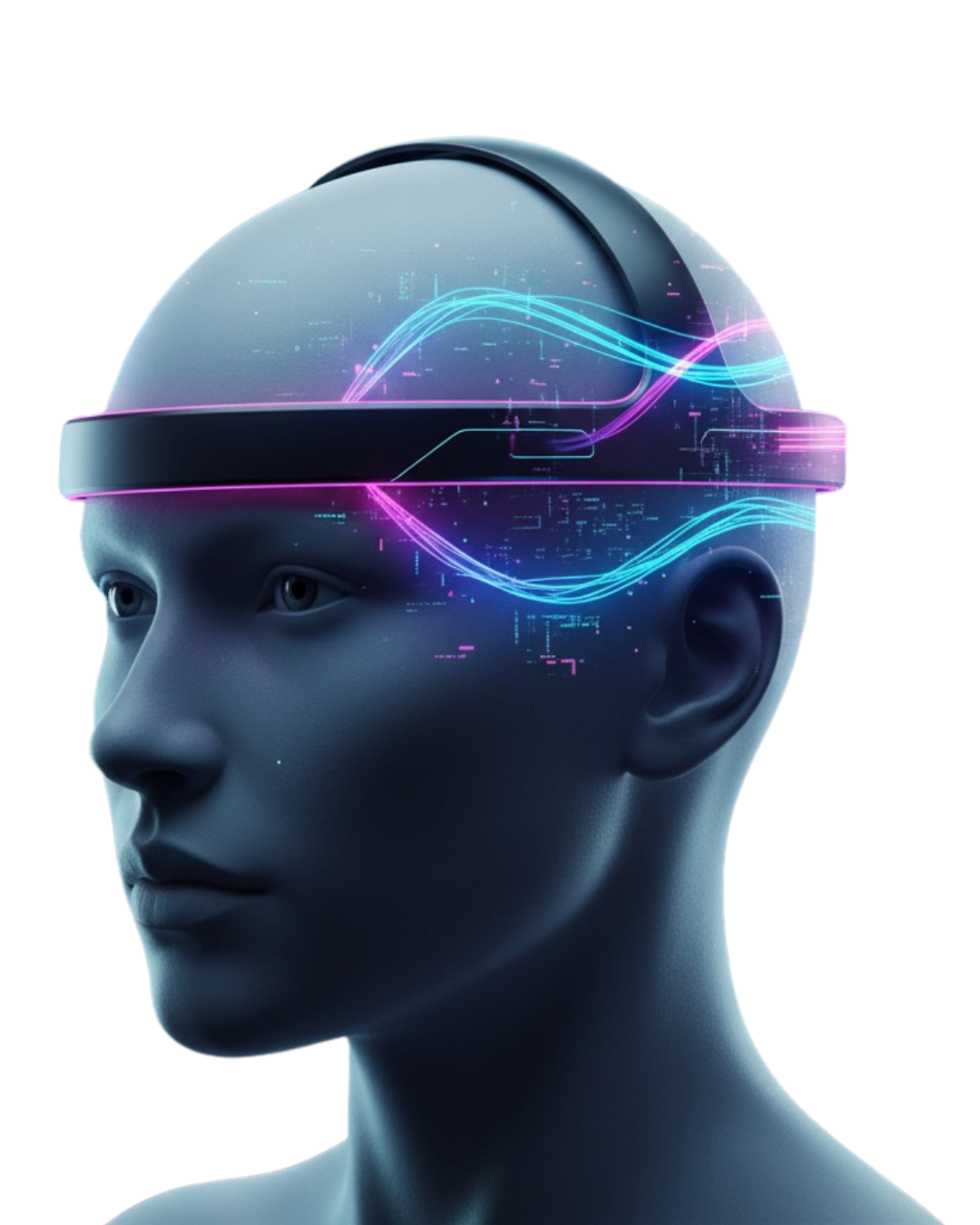
Scroll to explore the headband, open its layers and inspect the proposed electronics.
Explore the research ↓A headband concept exploring a more intuitive relationship with technology.
Non-invasive brain-computer interfaces do not record photographic thoughts; they capture microvolt-level potential fluctuations contaminated by 50/60Hz grid hum, eye blinks, and skin impedance. Test the simulated DSP pipeline below to see how raw noise is isolated into intentional frequency bands.
Synchronous post-synaptic potentials across occipital and parietal cortices. Indicates quiet wakefulness without visual stimulation. Used by Mind-Map as an baseline intent baseline.
The core idea is not a literal camera inside the brain. It is a pipeline: record measurable brain-related signals, learn which signal patterns correlate with known visual experiences, then use a model to construct an approximation. Research in neural decoding shows why this direction is scientifically interesting, while the limits of non-invasive sensing keep it firmly in the research-concept category for now.
A non-invasive sensor system records measurable neural and physiological signals during an experience.
Signal-processing and machine-learning models identify patterns correlated with attention, visual perception or recall.
A generative model creates a visual approximation from the decoded feature space rather than claiming to literally photograph a memory.
The user sees confidence levels, source signals and uncertainty instead of a false claim that the output is an exact memory.
EEG or future non-invasive neural sensors, eye tracking and contextual signals could provide the raw input.
Signal processing, multimodal ML and generative models could map noisy biological signals into interpretable features.
A consent-first interface could let users organize approximate reconstructions while keeping sensitive neural data local where possible.
Target electrical, mechanical and algorithmic thresholds derived from peer-reviewed BCI and robotics literature. All limits represent test criteria rather than commercial claims.
| ENGINEERING PARAMETER | TARGET THRESHOLD | PHYSICAL TOLERANCE / LIMIT | TEST RATIONALE |
|---|---|---|---|
| Electrode Array Topology | 8-Channel Biopotential (Fp1, Fp2, F3, F4, C3, C4, P3, P4) | Dry conductive Ag/AgCl polymer pins | Prefrontal and parietal positioning targeted for motor imagery (Mu-rhythm) and ocular artifact cancellation. |
| Analog Front End (AFE) | 24-Bit Sigma-Delta (Σ-Δ) ADC | < 0.8 µV RMS noise floor | High-resolution conversion required to distinguish 10-50µV EEG signals above ambient electromagnetic interference. |
| Input Impedance & Matching | > 1 GΩ @ 10 Hz | < 15 kΩ skin-contact threshold | Prevents signal attenuation without requiring conductive gels or skin abrasion. |
| Digital Filtering Pipeline | 4th-Order Butterworth (0.5 – 35 Hz) + 50/60 Hz Notch | < 18 ms group delay | Zero-phase IIR/FIR filter suppresses AC mains hum while preserving phase coherence in event-related potentials. |
| Wireless Telemetry & Latency | BLE 5.4 Isochronous Channels (2.4 GHz) | < 12 ms packet round-trip | Low-latency streaming allows near real-time feedback loops without tethering wires. |
| Power & Thermal Budget | 3.7V 320 mAh Li-Po (~8.5h continuous capture) | ΔT < 1.8°C over ambient | Thermal isolation prevents skin discomfort during sustained non-invasive usage. |
Today’s non-invasive consumer sensors cannot read a detailed visual memory like a camera. Any near-term prototype should focus on coarse states or perception-related patterns.
Brain-derived data is unusually sensitive. Encryption, explicit consent, local processing and deletion controls would need to be core product requirements.
A generated reconstruction can look convincing even when it is wrong. The system must present uncertainty and avoid framing synthetic output as factual recollection.
No wearable consumer headband currently does the complete thing imagined here: freely think of an arbitrary shape, object or sentence and have it reliably appear on a screen. But separate research lines have demonstrated important pieces of that pipeline. The gap between those pieces is the research opportunity for Mind-Map.
A 2021 study classified seven imagined geometric shapes from non-invasive EEG. Accuracy was limited, but it demonstrated that visual imagery can leave decodable patterns in scalp EEG.
Read study ↗Recent EEG research combines neural representations with diffusion models to reconstruct approximate images associated with visual brain activity. Most experiments decode images participants are viewing, not unrestricted private thoughts.
Read study ↗University of Texas researchers reconstructed the semantic meaning of perceived and imagined language using fMRI and a language model. The decoder required extensive participant-specific training and cooperation.
Read study ↗Brain2Qwerty shows increasingly strong non-invasive brain-to-text decoding during controlled typing tasks. It is an important milestone, but it is not yet a portable thought-reading headband or unrestricted inner-speech decoder.
Explore Brain2Qwerty ↗A scientifically defensible Gen-Smart prototype would start with intentional mental commands in controlled tasks, then expand only when validated. Instead of promising literal mind reading, the system estimates a semantic representation and exposes its confidence.
Research architecture — not a claim of current consumer capability. Early prototypes should use small, trained vocabularies and display uncertainty.
Multi-channel dry/wet electrodes capture non-invasive neural activity, with optional eye/physiological signals for artifact rejection.
Filtering, artifact removal, segmentation and subject calibration convert noisy recordings into usable features.
A personalized neural encoder estimates whether the user is intentionally imagining a trained shape, concept or language representation.
High-confidence semantic labels could retrieve a matching image from a curated database; generative AI could visualize approximate concepts.
The screen presents candidates and confidence, allowing the user to confirm, reject or refine the interpretation.
Train one participant on a small vocabulary such as circle, triangle, square and line. Target above-chance repeatable classification before attempting image generation.
Move to a constrained set of objects. Decode a semantic class, then retrieve several candidate images rather than claiming an exact mental picture.
Investigate deliberately rehearsed words or sentences using richer sensing and language priors. Free-form inner speech is a long-term research goal, not a near-term promise.
Mind-Map is open to collaborators who can help test the idea scientifically — from EEG acquisition and signal processing to machine learning, neuroscience and interface design. The goal is not to promise mind reading; it is to design measurable experiments and publish what actually works.
Tell us what you can build, test or research — and which part of the Mind-Map roadmap you want to work on.